LXIII
Glen Albyn Distillery, Inverness
November 14th, 1924

Glen Albyn, now one of the two distilleries owned by Mackinlays and Birnie, Limited, was founded in 1846 by the late Provost Sutherland of Inverness. Converted into a flour mill some twenty years later, the establishment was re-built as a distillery by Messrs. Gregory and Company in the year 1884.
In considering the immense output of Whisky in the Highlands nowadays, it may be interesting to point out that before the beginning of the nineteenth century Rum, Brandy, Strong Ale, and various Wines were much more popular in Scotland that the product of “John Barleycorn.” Colonel Stewart, of Garth, writing in 1820, said “Till within the last thirty years Whisky was less used in the Highlands than Rum and Brandy, which were smuggled from the west coast. It was not till the beginning, or rather towards the middle, of last century that Spirits of any kind were so much drank as Ale, which was then the universal beverage. Every account and tradition goes to prove that Ale was the principal drink among the country people, and French Wines and Brandy among the gentry.” According to the same authority the “strong frothing Ale from the cask was drunk from a circular shallow cup with two handles. Those of the gentry were of silver, and those used by the common people were of variegated woods. Small cups were used for Spirits. ‘Whisky house’ is a term unknown in Gaelic. A public-house, however, is called ‘Tigh-Leanna (i.e., ‘Ale house.’)” The writer adds a further note on the drinking of Whisky: “Whisky drank in the Highlands of Perthshire” (before the nineteenth century) “was bought principally from the Lowlands. A ballad composed on an ancestor of mine in the reign of Charles I. describes the Laird’s jovial and hospitable manner, and, along with other feats, his drinking a brewing of Ale at one sitting. In this song Whisky is never mentioned, nor is it in any case, except in the modern ballads and songs.”
From this, and other evidence more definite and substantial, it would appear that the manufacture and use of Whisky was extremely limited before the end of the eighteenth century. The first record of duty paid was in the year 1707, when it amounted only to £1,810 15s. 11d., representing about 100,000 gallons, the Scottish population then being 990,000. In 1724 duty was charged upon only 145,602 gallons, with a population of little over a million. In contrast to these figures we find that by 1884, when Glen Albyn was re-built, the population of Scotland had increased nearly four times, the quantity of Spirits charged for home consumption forty-five times, and the amount of duty over nine hundred and forty-seven times! Unless the Excise duties were evaded on an enormous scale in the eighteenth century, one may assume that in the year 1884 Scotsmen consumed eleven times as much Whisky as they did in 1724!
In support of Colonel Stewart’s assertion concerning the lack of Whisky drinking among the eighteenth century Highland “gentry,” we have a letter of Lord Lovat, written in 1739, when he had occasion to entertain twenty-four guests at Beaufort Castle: “I have ordered John Forbes to send in horses for all Lachlin Macintosh’s Wine, and for six dozen of the Spanish Wine.” Here, again, is no mention of what was to become the “national drink” of Scotland. A Highland poet, Ian Lour, sings the praises of Wine about the same period, and makes no reference to Whisky.
Inverness is an important centre of the tremendous trade in Highland Whisky to-day, and Glen Albyn, like its sister distillery, Glen Mhor, has an admirable situation for carrying on business. The premises lie at the mouth of the Caledonian Canal, so that ships from Glasgow and Leith can bring supplies of barley to the very door of the maltings. Grain is taken in by an elevator to a screening plant, and afterwards steeped in two vessels of 50 quarters’ capacity. The two germinating floors are large and well ventilated, and from them another elevator conveys the malt to the kiln, where a King’s patent turner is installed. Patent regulators are attached to the kiln furnaces. For grinding purposes an old-fashioned two-roller mill is in use, but this machine will shortly be replaced by one of the most modern design. The malting machinery is operated by three first-class electric motors.
Twelve hundred bushels of malt are mashed weekly, two steam heating tanks providing mashing water. A Tangye steam engine drives the mashing plant, and, as in most up-to-date distilleries, there are pumps for wart and wash, and a powerful steam boiler. Six backs for fermentation are placed in the tun-room, and two new stills, of 2,500 and 2,033 gallons capacity respectively, were installed last year. There are two warehouses at Glen Albyn, and a cooperage of unusual size, where casks are made ready for filling.
The water supply comes from Loch Ness, as in the case of Glen Mhor Distillery, and it is interesting to observe that the two establishments, lying almost side by side, and using the same water, each produce different Whiskies.
Perhaps, in conclusion, it may be noteworthy that Glen Albyn was during the War the chief U.S. Naval headquarters for the manufacture of mines.
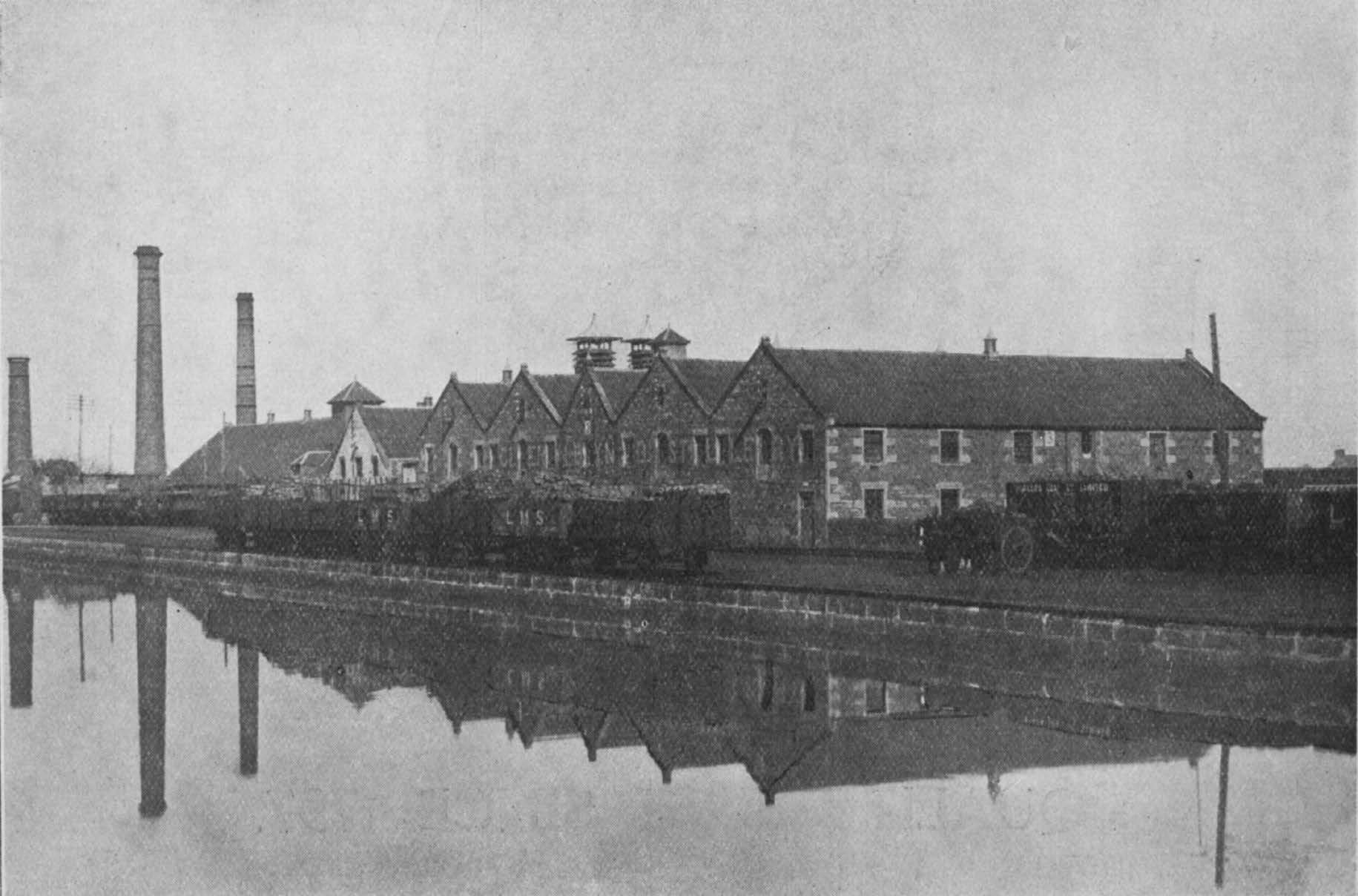
Glen Albyn Distillery from the Caledonian Canal.
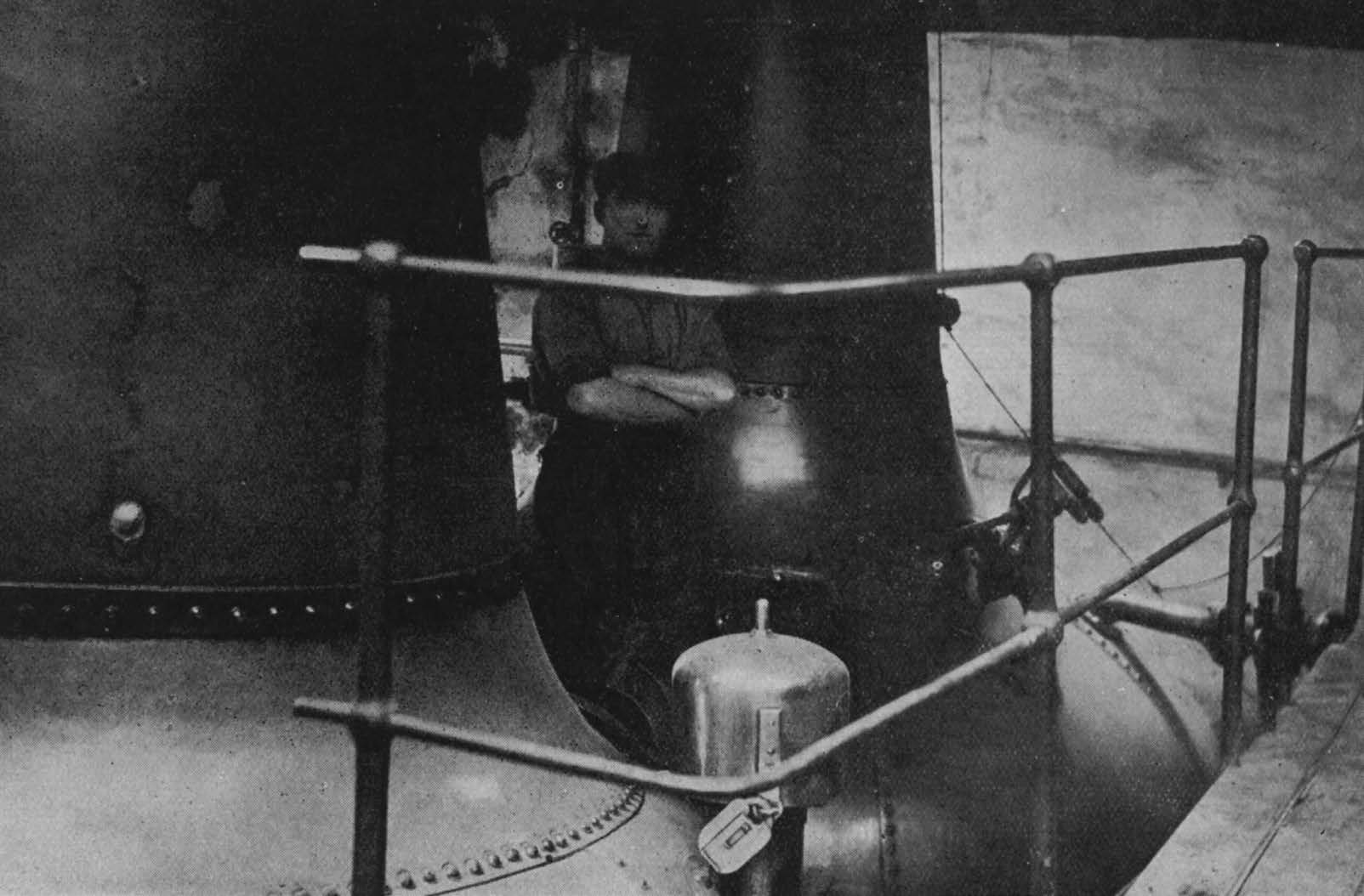
Glen Albyn : Still House.
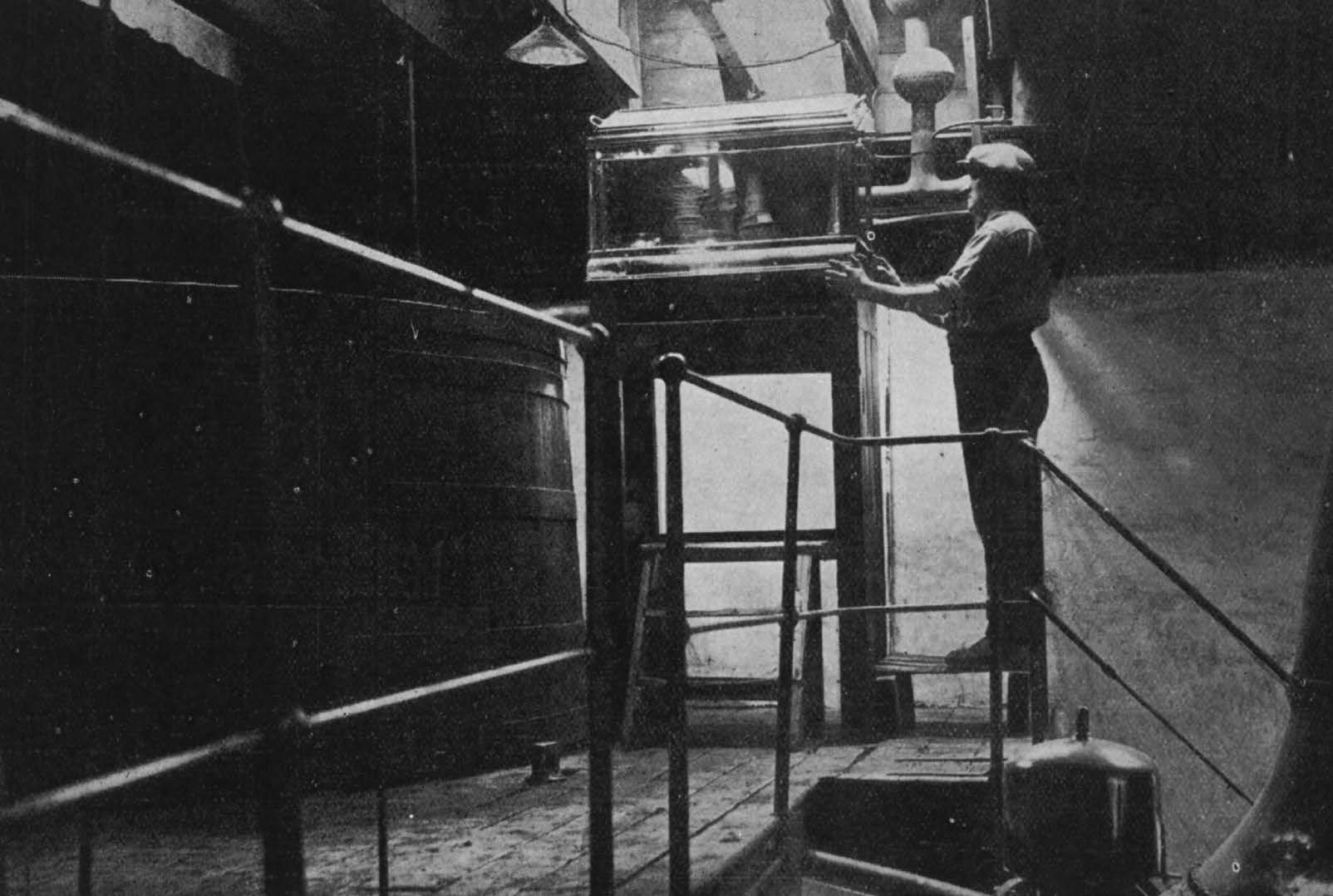
Glen Albyn : Spirit Receiver and Safe.
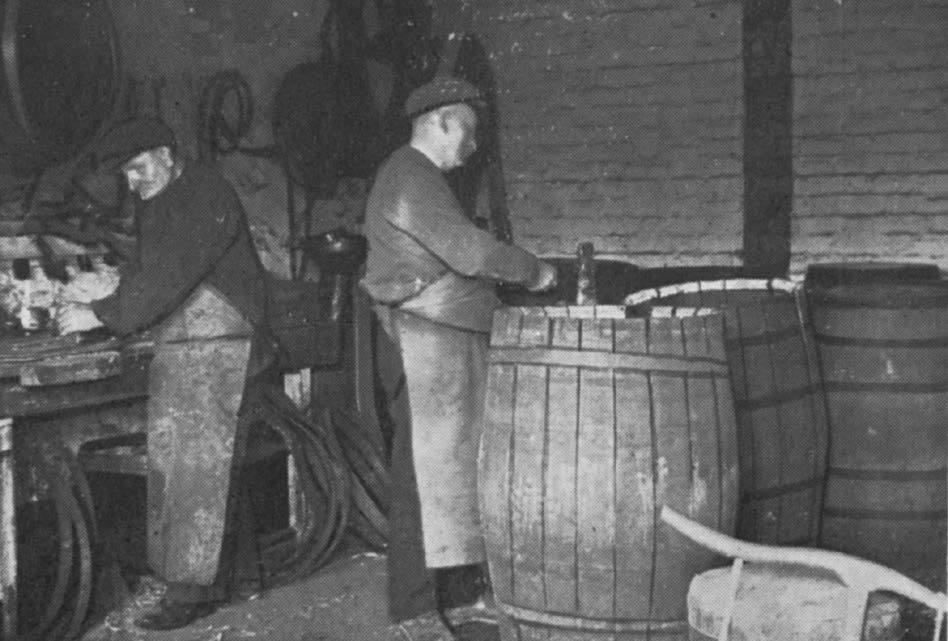
Glen Albyn : Cooperage.
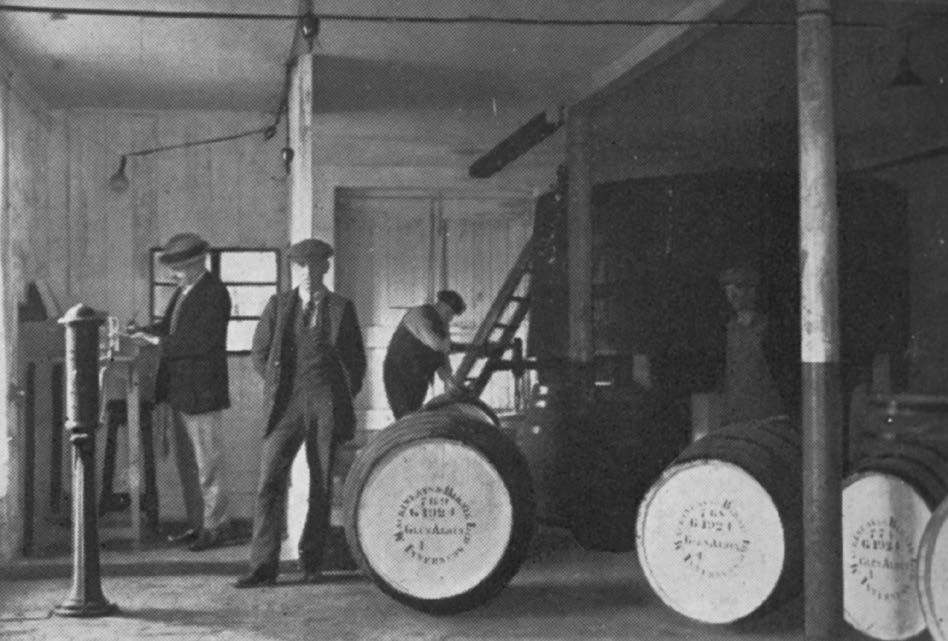
Glen Albyn : Spirit Store.


Images © The British Library Board