LXVIII
Ord Distillery, Ross-shire
January 14th, 1925

Considering the magnificent natural surroundings in which it is produced, one can scarcely wonder at the purity and general excellence of Highland Malt Whisky.
Like most of the Ross-shire distilleries, Ord, which belongs to Messrs. John Dewar and Sons, Ltd., of Perth, is set in a rugged landscape of heather-carpeted hills, sparkling streams, and deep wooded glens, softened here and there by vast stretches of fertile pastureland. The distillery lies in a sheltered valley within a mile of Muir of Ord village, which is situated on the London, Midland and Scottish railway line some fifteen miles north of Inverness.
This locality has for centuries been associated with the manufacture of Whisky, legitimate and otherwise, ranging from the crude Spirit of the old “bothies” to the finely-flavoured Highland Malt that has been gradually brought to perfection by the scientific methods employed at Ord. Before the establishment was opened as a legal distillery in the year 1838, the site actually contained a large smugglers’ “bothy,” which appears to have been only one of many in the district.
Ross-shire men can still remember a particularly resourceful smuggler who bore the picturesque nickname of “Black Sandy” and greatly harassed the Revenue officers as late as the “eighties” of the past century. “Black Sandy” must have been an amusing character, for he seems to have flouted the authorities with the utmost good humour, openly conveying his new “make” to his own private markets in a small horse-drawn vehicle. The Excise men were always strongly suspicious concerning the contents of that innocent looking cart, but “Black Sandy” had an uncanny knack of slipping through the traps set for him. On one occasion he concealed a keg of Spirits under a bee-hive, and made for a neighbouring village. He was soon accosted on the road by a “gauger,” who knew him well, and had often been hoaxed by him.
“Stop!” shouted the officer sternly, “what have you got in that cart?”
“I’ve naethin’ mair than a lot of bumble bees,” replied Sandy.
The cart was searched, but the officer failed to examine the bee-hive minutely, and in a few seconds the wily old smuggler was on his way again, whistling cheerfully.
As in other parts of the Highlands, many curious legends still linger among the hills and plains of Ross-shire. Near Conan House, the seat of the Mackenzies of Gairloch, and not far from Ord Distillery, is an ancient burying-ground consecrated to St. Bride or Bridgit of Kildare, who lived from 450 to 521 A.D. In the centre is a mound believed to have been dedicated to the still earlier Brigit or Bridhge, a sun goddess sacred to the Celts.
Muir of Ord was until about forty years ago one of the two principal live-stock markets in Scotland. Distilling is now the only considerable industry in the village, and the distillery ranks as one of the best equipped establishments in the north of Scotland.
A copious supply of water reaches the premises from two lochs hidden in the hills, and a concrete reservoir 14 feet deep has been constructed to hold over a million gallons. Only the finest barley is used, and the maltings consist of four germinating floors, two grain lofts, four steeps, and two kilns. The barley is dressed in a Porteous machine operated by an electric motor. One of the kilns is fitted with a King’s turner, and the furnaces are regulated by King’s patent regulators, and have cement inverts. An exceptionally good Porteous mill is capable of grinding the malt at a rate of 25 quarters an hour.
At Ord 2,300 bushels of malt are mashed weekly, and the tun-room contains eight fermenting backs. Mashing water is supplied from two coppers and a heating tank.
Four stills (manufactured by Robert Willison, of Alloa) are maintained, and the warehousing accommodation is sufficient for storage of nearly a million gallons of Whisky.
Water driven by a turbine is the main source of power at Ord Distillery, but in case of emergency a first-rate 40 h.p. horizontal steam engine (manufactured by G. Chrystal, of Perth) provides subsidiary power. Other machinery includes a draff-dryer, and a draff drag for removing the wet residue from the mash-tun.
It should be added that a visit to Ord Distillery is rendered particularly pleasant, owing not only to the efficient working and equipment of the premises, but also to the scrupulous cleanliness and tidiness that extends to every corner.
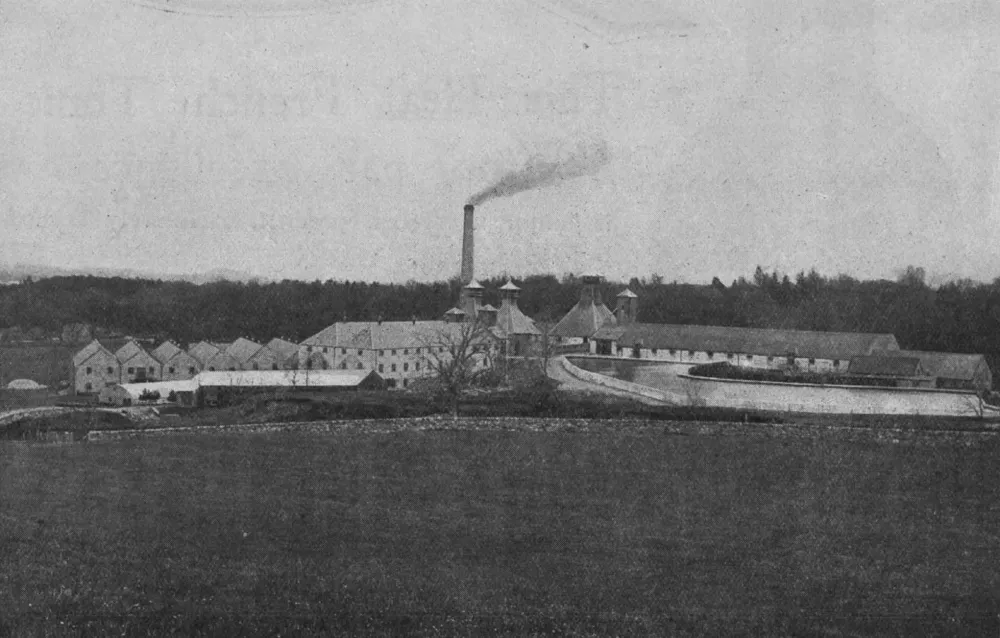
Ord Distillery, Ross-shire.
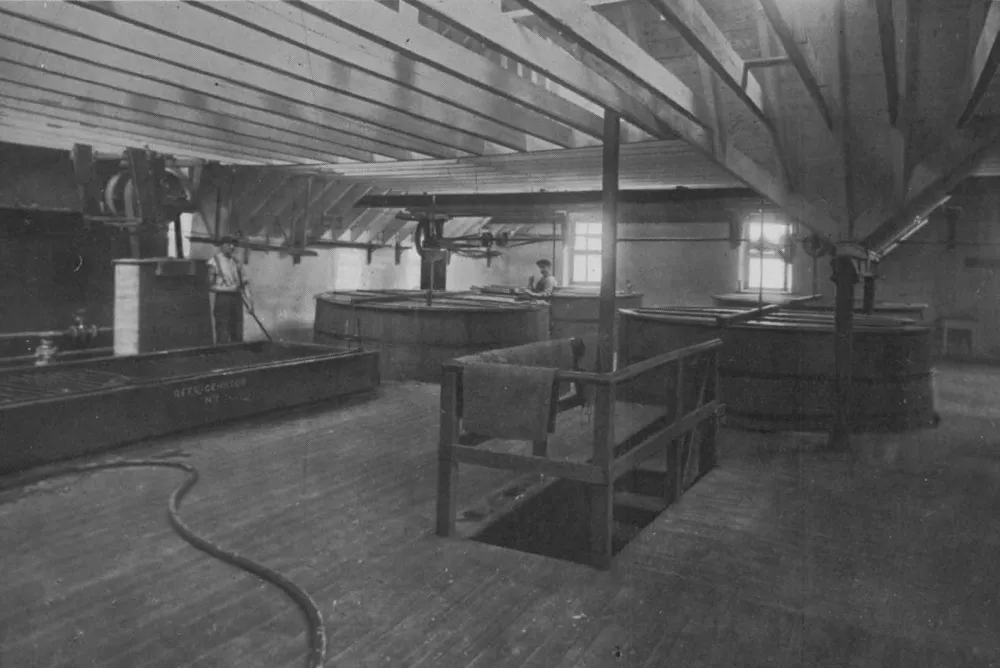
Ord Distillery : The Tun Room, showing one of the Refrigerators.
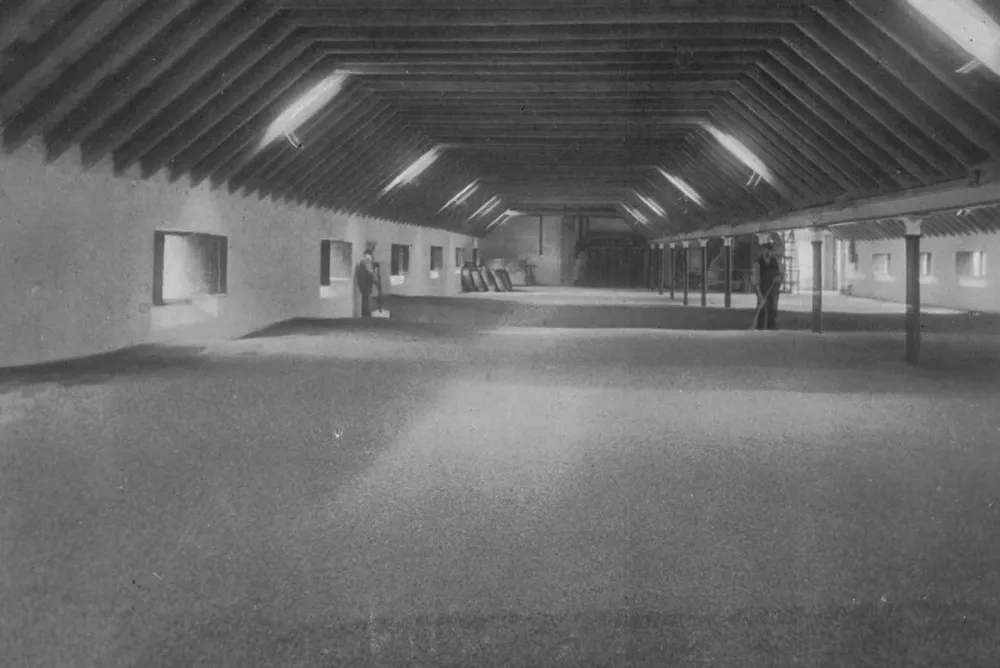
Ord Distillery : The Grain Loft.
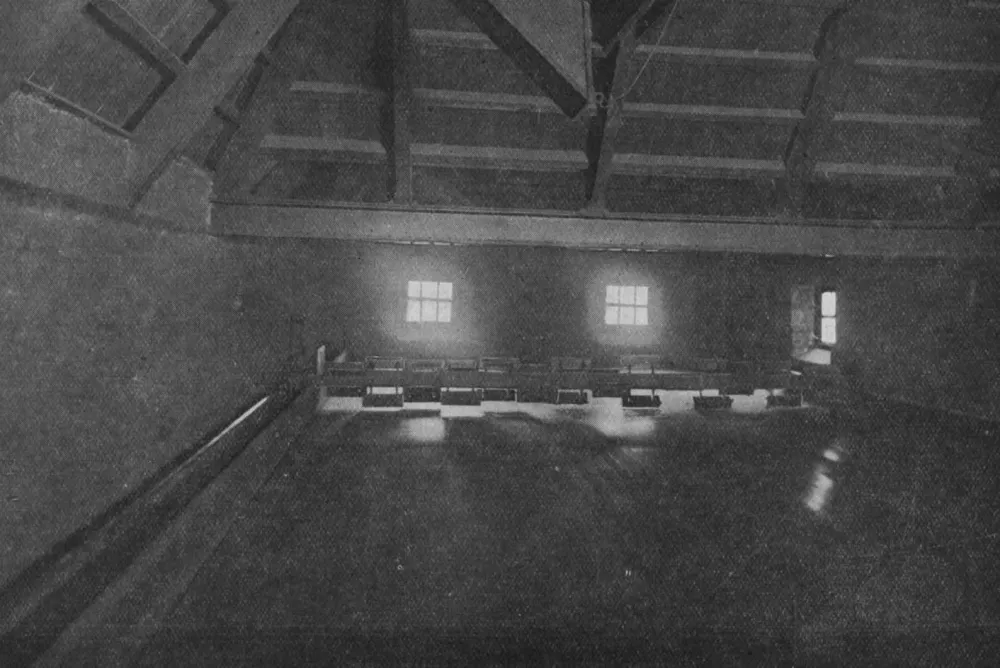
Ord Distillery : Kiln, showing turners.
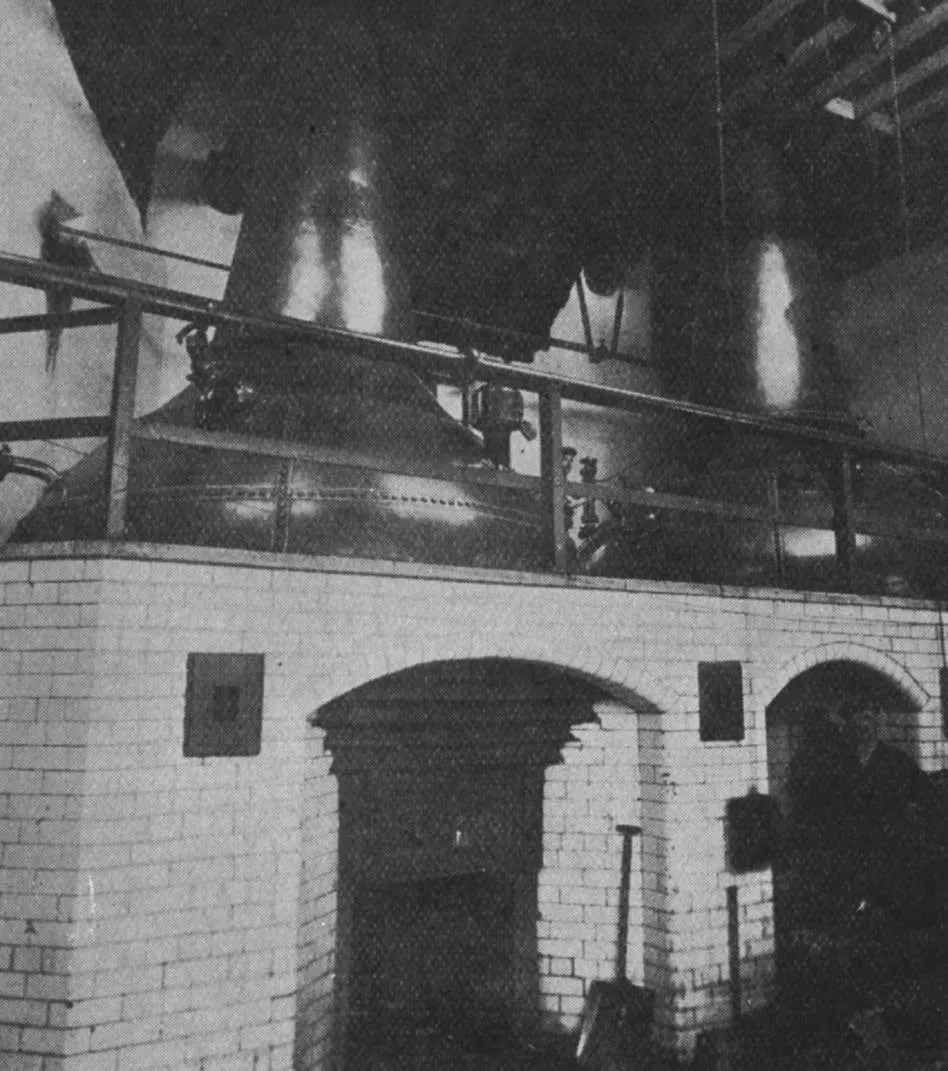
Ord Distillery : Two of the Stills.


Images © The British Library Board