CX
Tobermory Distillery, Isle of Mull
November 13th, 1926

Founded in 1823, Tobermory Distillery, situated on the exceedingly picturesque Island of Mull, is one of the oldest Highland malt distilleries. Although well over a century old, the buildings, ideally situated, are constructed of stone and are well adapted for the purposes of a distillery. Whilst of somewhat more extensive dimensions than those of more recent erection, they indicate a span of existence likely to exceed the life of those of modern build. Tobermory Distillery is situated at the foot of a very steep range of thickly-wooded hills, and seen from the sea forms an imposing and attractive structure.
Tobermory is the chief town in the island, and takes its name from “the Well of Mary,” which is reputed by legend to possess healing virtues, a thing still believed in by many of the inhabitants. The town traces its origin to the Society for the Encouragement of the British Fisheries, which commenced operations here in 1788, but the hope reposed therein has not been realised. To-day, Tobermory Distillery is the primary industry of the town, and is well-known to tourists.
The original pier erected for the town has been replaced by a more modern and commodious structure, but it is to the old pier that the barley for the distillery, principally Scottish grown, is brought by one hundred ton “puffers,” as they are colloquially described. The old pier is only a short distance from the grain loft, which has dimensions of 160 ft. by 18 ft. After cleansing, a travelling band is used for filling the two steeps, each with a capacity of 40 quarters. On an average 120 quarters are steeped weekly in the season.
There are three large cement malting floors, 160 ft. by 18 ft., and the malt kiln, which is loaded by elevators, has a wire gauze floor 33 ft. by 27 ft. The furnace is shot into the three malt deposits by means of chutes. The weighing is done by a Symon automatic weighing machine, and screen conveyors carry the grain to one of the latest pattern Boby’s two high-speed mill. There are four grist hoppers with a total capacity of one thousand bushels. The brewing tanks, which hold nearly four thousand gallons of water each, are heated by steam.
The water for use in the distillery is drawn from the Tobermory burn, which falls over numerous waterfalls on its course towards the sea, and is fed from the Mishnish Loch. The water from the famous St. Mary’s Well intermingles with the burn water before reaching the distillery, and thus brings its reputed virtues into this famous make of Highland malt. The mash tun has a capacity of three hundred bushels, and in the season there are four mashes each week. The underback is situated at a lower level than the mash tun, which is drained by gravitation. The wort is pumped by a centrifugal pump to the receiver, which has a capacity of five hundred gallons. Cooling is effected by a Miller refrigerator, and four fermenting washbacks are provided, with a capacity of over 6,500 gallons each. The wash-backs are discharged by gravitation. The wort discharger has a capacity of six thousand gallons, and the wash-still, which is furnace heated, a capacity of 2,730 gallons. The low-Wines and feints receiver charger is filled by gravitation. The low-Wines still, which has a working capacity of 1,739 gallons, is steam heated. The Spirit receiver capacity is one thousand gallons. A large Lancashire boiler is used for heating and steam power, whilst a steam engine is provided as auxiliary power. The distillery machinery is driven by a twenty horse-power turbine worked by the water from the Mishnish Loch, and there is never any handicap of water shortage on this burn. There are one large and two small bonded warehouses.
The proprietors of Tobermory are Messrs. John Hopkins and Co., Ltd., 133, Waterloo Street, Glasgow, and Kinnaird House, 2, Pall Mall East, London, S.W. 1.
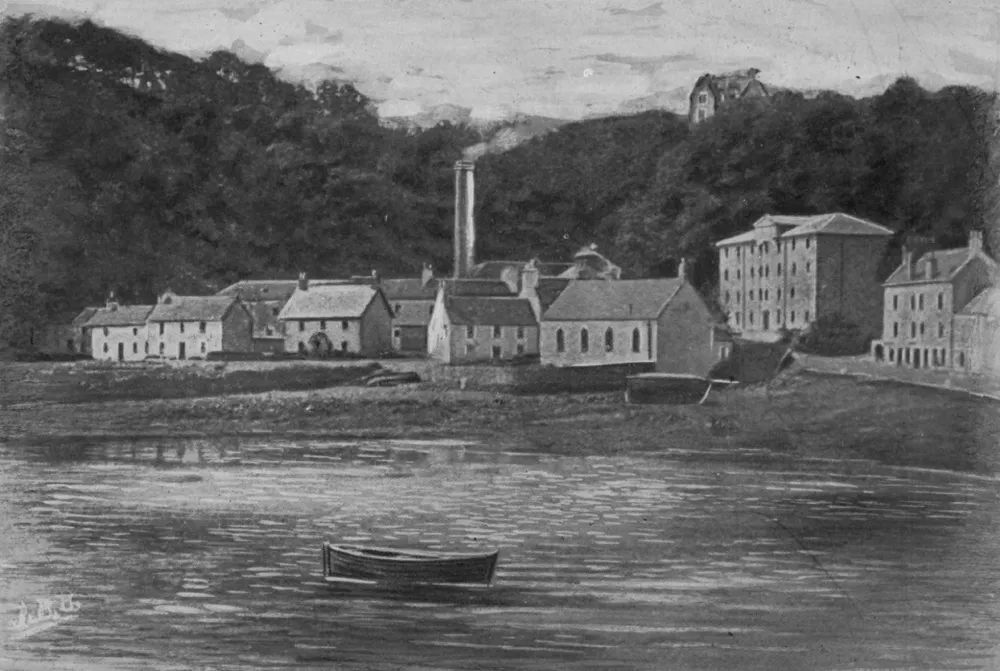
Tobermory Distillery, Isle of Mull.


Images © The British Library Board